
A sentence can feel familiar while you listen and fall apart when you say it. MirrorSay puts the reference, your recording and word-level timing together so you can find one useful adjustment, rather than chase a perfect-looking score.
Know which sentence you are practising
After free speech, the target is the natural version. After adding or importing a sentence, the target is the text you selected. Keep those paths separate.
Read the target and make sure you understand it. If every word is new, deal with meaning first; otherwise it is hard to tell whether you are communicating or only chasing sounds.
Pass one: listen before you chase the audio
Play the reference all the way through. Notice the main stressed words, the connected chunks, and whether the ending sounds finished, open or questioning.
On the second listen, speak quietly along with it. If the sentence is too long, practise a complete thought group first. Speeding through words you cannot yet process is not fluency.
Pass two: check content before timing
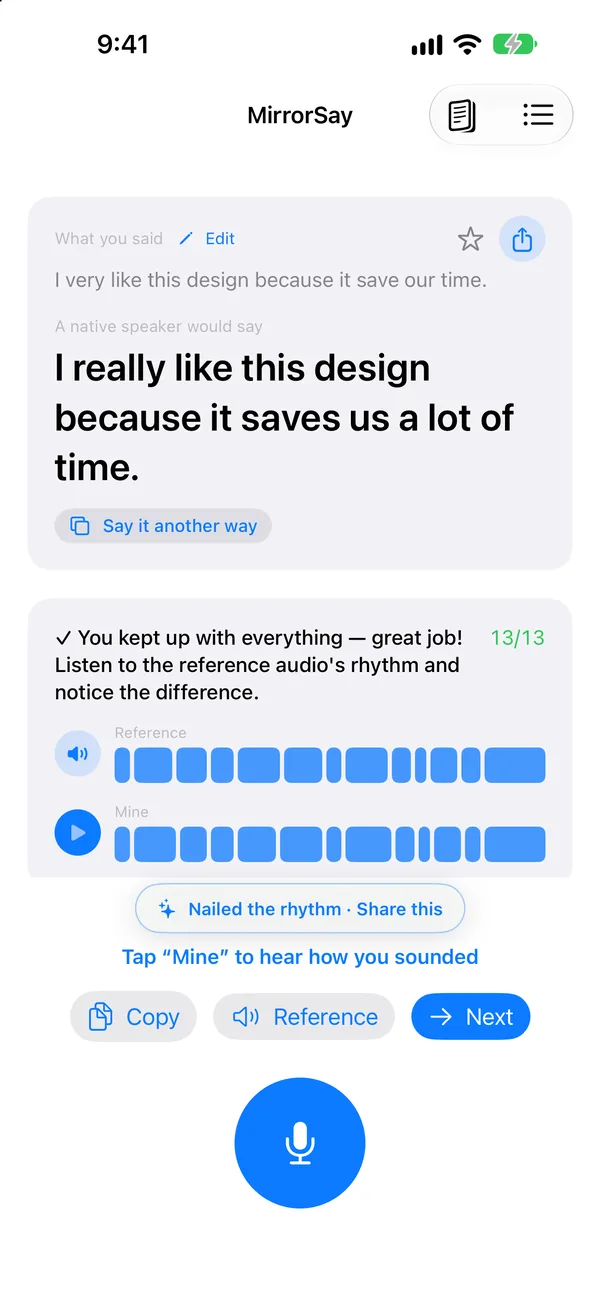
Hold the microphone, say the target, release and inspect the comparison. The two rows represent the reference and your attempt; each segment corresponds to a word. They offer clues about alignment, relative duration and pauses. They do not diagnose every phoneme.
Ask three questions:
- Did I omit a whole word, or did recognition miss it?
- Did one long hesitation compress everything after it?
- Is every word equally prominent, so my main point disappears?
“All matched” means the current detection found the target sequence in this attempt. It is not a claim of native-level English or perfect pronunciation in every context.
Pass three: replay your voice and choose one action
Tap your recording, then compare the same part of the reference. The bars are clues; your ears make the final check. Choose only one correction:
- Missing word: practise that word with its neighbours, then return to the sentence.
- Rushing: pause at a meaningful boundary, not after every word.
- Flat stress: bring out the one word that carries your point; let the rest support it.
- Unclear ending: say the last three or four words clearly, then reconnect them.
If recognition varies a lot between attempts, move somewhere quieter and keep a steady microphone distance. Do not blame every missed word on your accent.
Two focused retries are enough
Use the first retry to fix the most obvious issue and the second to check it. When your meaning is complete and understandable, allow yourself to move on. Repeating ten times without listening is usually less useful than three deliberate cycles.
Star useful sentences for later. For new material, see Add your own sentence and Import an article or screenshot. For the research context, read Does shadowing work?.
FAQ
Why do my bars not exactly match the reference?
Natural repetitions vary, and detection is affected by speed, pauses, noise and recognition. Focus on meaning and continuity, not pixel-perfect bars.
Is faster always better?
No. Establish content and intelligibility first. Speed gained by swallowing endings or flattening stress is not useful progress.
Can it tell whether my th or vowels are correct?
Do not use it as a phoneme judge. Timing feedback supports whole-sentence practice; individual sounds need targeted listening and articulatory guidance.